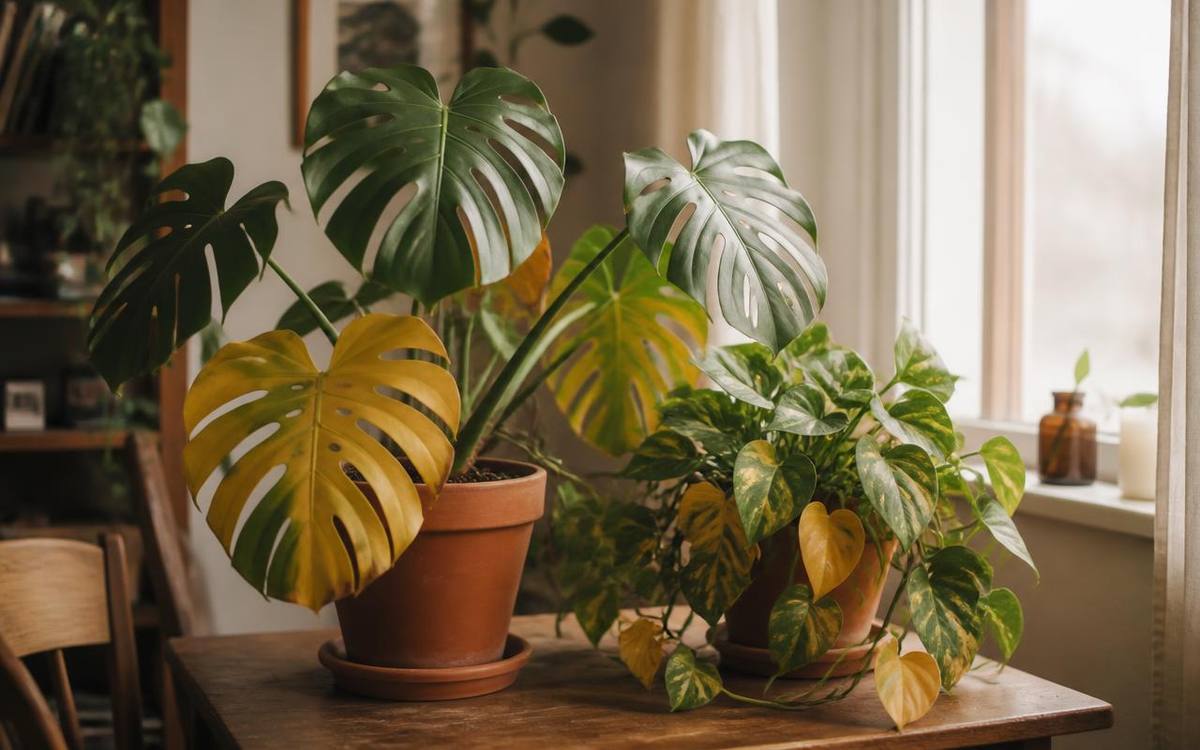
Why Are My Plant Leaves Turning Yellow? 7 Causes and How to Fix Them
By Planthead · Aug 31, 2026
Yellow leaves are not a death sentence. They are a message. The tricky part is that almost everything a houseplant dislikes shows up the same way: a green leaf slowly going pale, then yellow, then crispy.
The good news is that the pattern of yellowing tells you what is wrong. Which leaves went yellow, how fast, and what the soil feels like will point you straight at the cause.
First: check the soil before you do anything
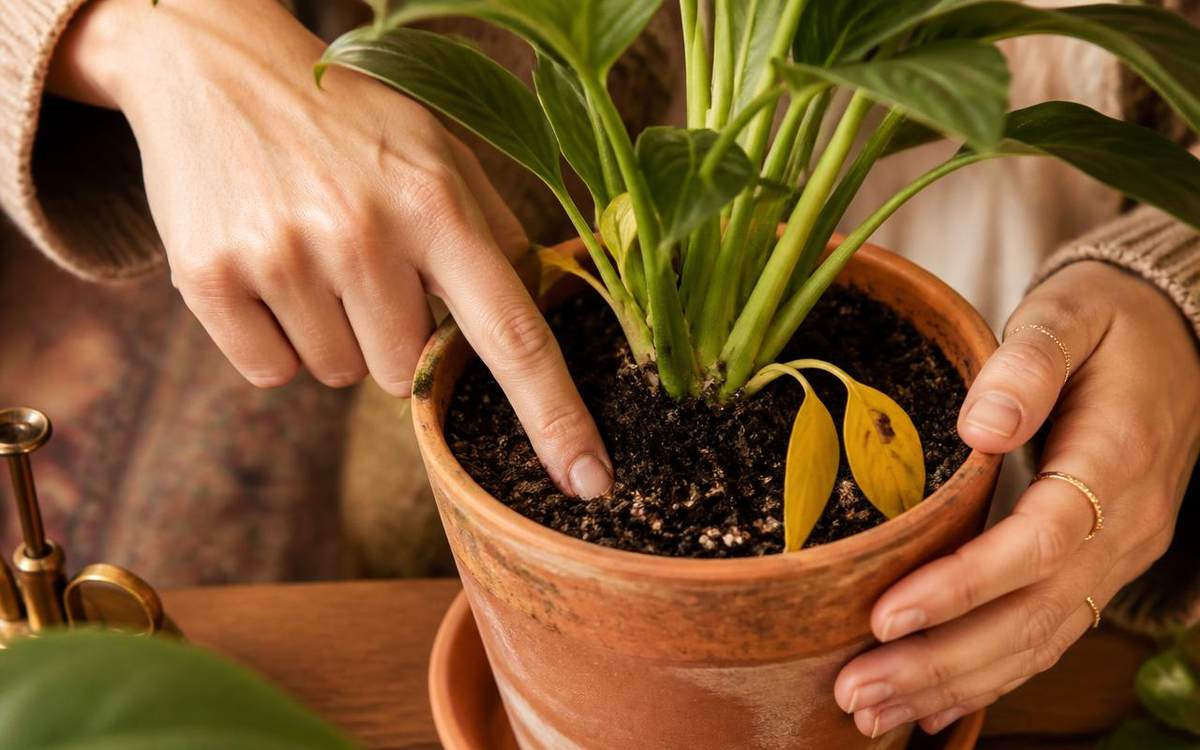
Before you diagnose anything, push a finger two knuckles deep into the soil.
- Wet and heavy → suspect overwatering or drainage.
- Bone dry and pulling away from the pot → suspect underwatering.
- Evenly slightly damp → the cause is probably light, nutrients or pests.
That one test eliminates about half the possibilities in five seconds.
1. Overwatering (the usual suspect)
Looks like: lower leaves turn soft, uniformly yellow, sometimes with brown mushy patches. Soil stays wet for days. There may be a sour smell.
Why: roots sitting in water cannot take in oxygen. Drowning roots stop feeding the leaves, and the plant sacrifices the oldest ones first.
Fix: stop watering. Let the top 3–5 cm dry out fully before the next drink. Make sure the pot has a drainage hole and empty the saucer every time. If the soil smells bad, unpot it, trim any brown mushy roots, and repot into fresh, airy mix.
2. Underwatering
Looks like: yellowing that arrives with crisping. Leaves feel thin and papery, edges brown, the whole plant looks slightly deflated.
Fix: water thoroughly until it runs from the drainage hole, then let it drain. If the soil has shrunk away from the pot, water repels off the surface — bottom-water by standing the pot in a tray for 20 minutes instead.
3. Not enough light
Looks like: pale, washed-out yellowing across newer growth, leggy stems reaching toward the window, small new leaves.
Fix: move it closer to a window — most houseplants want bright indirect light, which in practice means within a metre or two of a window they can "see" the sky from. Rotate the pot a quarter turn each week so every side gets its share.
4. Too much direct sun
Looks like: bleached yellow or white patches on the leaves facing the window, sometimes with dry brown scorch marks in the middle of the leaf.
Fix: pull the plant back from the glass or diffuse the light with a sheer curtain. Sunburned leaves will not recover, but new growth will come in correctly.
5. Nutrient deficiency
Looks like: yellowing between the veins while the veins themselves stay green (classic magnesium or iron shortage), or a general fade across older leaves (nitrogen). Common in plants that have lived in the same soil for over a year.
Fix: feed with a balanced liquid houseplant fertiliser at half strength during the growing season, roughly every 3–4 weeks. If it has been more than 18 months, refresh the top layer of soil or repot.
6. Pests
Looks like: yellow stippling or tiny pale dots, often with fine webbing (spider mites), sticky residue (scale, mealybugs), or little flies around the soil (fungus gnats — usually a symptom of overwatering).
Fix: isolate the plant. Wipe leaves — both sides — with soapy water or diluted neem, and repeat weekly for three weeks to break the life cycle.
7. It is just an old leaf
Looks like: one lower leaf, occasionally, turning yellow while everything above it is thriving.
Fix: nothing. Plants retire old leaves and reinvest the nutrients in new growth. Snip it off and get on with your day.
Should you cut yellow leaves off?
A fully yellow leaf will not turn green again — the chlorophyll is gone. Remove it once it is more yellow than green, cutting cleanly near the stem. A partially yellow leaf is still photosynthesising a little, so leave it until it gives up.
The part that actually solves this
Most yellow leaves are a timing problem, not a knowledge problem. You know your monstera should dry out between waterings — you just cannot remember whether you watered it last Tuesday or the Tuesday before.
That is exactly what Planthead is for. Log each watering with a tap, and the app tells you which plants are actually thirsty instead of leaving you guessing. Photograph a leaf when it starts to yellow and you will have a timeline showing whether it is getting worse or growing out of it. Group your plants into shelves by room, so the dark-corner plants and the sunny-window plants get treated differently.
Curious about the wider story of yellowing? We also wrote a plant parent's guide to yellow leaves, and if your plant is still a mystery species, here is how identification works without an app.
FAQ
Why are my plant's lower leaves turning yellow first?
Plants pull resources from their oldest leaves first, so lower leaves are the first to yellow under stress. Combined with wet soil, it almost always means overwatering; combined with dry, crispy edges, it means the plant needs more frequent watering.
Can a yellow leaf turn green again?
No. Once a leaf has lost its chlorophyll it will not recover, so judge your fix by the new growth rather than the damaged leaf. Remove leaves that are more yellow than green.
How often should I water my houseplants?
There is no universal schedule — it depends on the plant, pot size, light and season. Check the soil instead: water most houseplants when the top 3–5 cm feels dry, and log each watering so you can see the real interval your plant prefers.
Does yellowing mean I need fertiliser?
Only if the yellowing appears between the veins or across older leaves in a plant that has been in the same soil for a year or more. If the soil is soggy, feeding will make things worse — fix the watering first.
Keep reading 🌿
Grow with Planthead 🌱
Track watering, log growth, earn badges. The app for accidental jungle owners.
Open the app