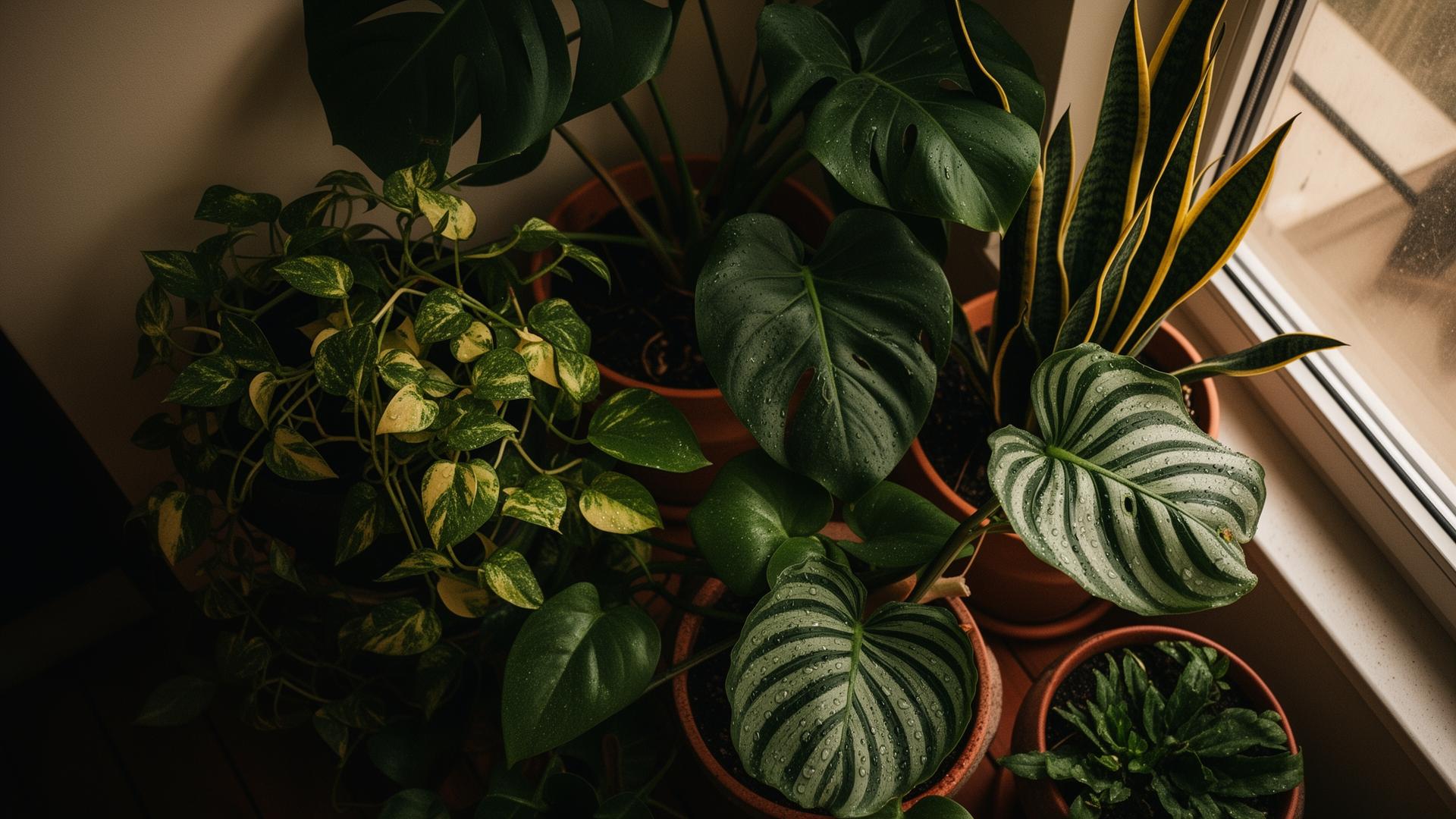
The Secret Social Life of Houseplants
By Planthead Team · Jun 4, 2026
TL;DR — Plants are not silent décor. They swap chemical messages, share nutrients through soil networks, and respond to vibrations. Cluster your houseplants and you’ll get a happier, healthier mini-ecosystem on your shelf.
We like to think of our houseplants as quiet roommates. They don’t hog the Wi-Fi. They don’t leave dishes in the sink. They just… sit there, looking photogenic.
Except they don’t just sit there. Behind those glossy leaves and dramatic fenestrations, your plants are running a tiny social network — sending chemical DMs, eavesdropping on each other, and occasionally throwing shade (literally). Once you know what’s happening, you’ll never look at your shelf the same way again.
1. Your pothos is sending invisible texts
When a leaf gets nibbled, stressed, or even gently bruised, plants release volatile organic compounds (VOCs) — airborne molecules that drift to nearby leaves. Neighboring plants pick up the signal and start pre-emptively beefing up their own defenses, like a group chat warning "heads up, fungus gnats incoming."
This isn’t fringe science. Researchers have watched tomato, lima bean, and sagebrush plants do it in the wild. There’s no reason your pothos is exempt. It’s just doing it quietly, in a language we can’t smell.
2. There’s a tiny internet in your soil
Under the dirt, mycorrhizal fungi weave thread-like networks between roots. Scientists nicknamed the outdoor version the "wood wide web" because it lets trees swap sugars, water, and warning signals — sometimes between completely different species.
In a single pot, that network is small. But put a few plants close together with healthy soil, and those fungal threads start to bridge the gap. Older, established plants can essentially babysit younger cuttings nearby, sharing resources through the underground. Your propagation station is basically a daycare.
3. They can "hear" — kind of
This one sounds like a TikTok myth, but it keeps showing up in peer-reviewed papers. Plants don’t have ears, but their cells respond to vibrations. Beach evening primrose has been shown to produce sweeter nectar within minutes of detecting a bee’s wingbeat frequency. Roots will grow toward the sound of running water. Some studies even pick up faint clicking sounds from drought-stressed stems — the botanical equivalent of a sigh.
So when you talk to your monstera? You’re probably not getting through with the words. But the gentle vibrations of a human voice (and the CO₂ you exhale right onto its leaves) genuinely don’t hurt.
4. Why grouping plants actually works
All of this adds up to a very practical houseplant hack: plants do better in groups than alone. A cluster of plants creates its own microclimate:
- Humidity goes up. Each leaf transpires water vapor. Five plants huddled together raise local humidity by 10–20% — exactly what calatheas, ferns, and most aroids are begging for.
- Pests get spotted faster. A diverse group means pests have a harder time exploding on a monoculture, and the early-warning VOC system kicks in.
- Light gets shared. Taller plants throw dappled shade for understory friends like peperomias and prayer plants, which actually prefer it.
- You water more consistently. Be honest — a clustered "jungle corner" is way harder to forget than one lonely plant on a far shelf.
5. How to throw your plants a proper party
Ready to turn your shelf into a tiny ecosystem? A few ground rules:
- Group by vibe, not just looks. Cluster plants with similar light and humidity needs. Tropical aroids together. Succulents and cacti in their own sunny clique. Don’t make a fern share a south window with an echeveria — that’s a bad blind date.
- Leave breathing room. Touching leaves is fine; smushed leaves are not. You want airflow between pots to keep fungal issues away.
- Add a humidity anchor. One big-leaved plant (monstera, philodendron, alocasia) acts as the humidity engine for the whole group.
- Rotate weekly. Plants on the back row get less light. A quarter-turn every time you water keeps everyone growing evenly.
- Mind the introductions. New plants get a two-week quarantine away from the group. Pests travel in friend groups too.
- Use a tray. A pebble tray or shallow saucer under the cluster bumps humidity even more and catches drips. Your floor will thank you.
The takeaway
Your houseplants aren’t passive décor — they’re a low-key social network running on chemistry, fungi, and good vibrations. Give them company, give them airflow, and give them the occasional pep talk. You’re not weird. You’re just speaking their language.
Now go rearrange your shelf. Your pothos has things to say.
Keep reading 🌿
Grow with Planthead 🌱
Track watering, log growth, earn badges. The app for accidental jungle owners.
Open the app